Thursday, September 22, 2011

A big day, Thursday

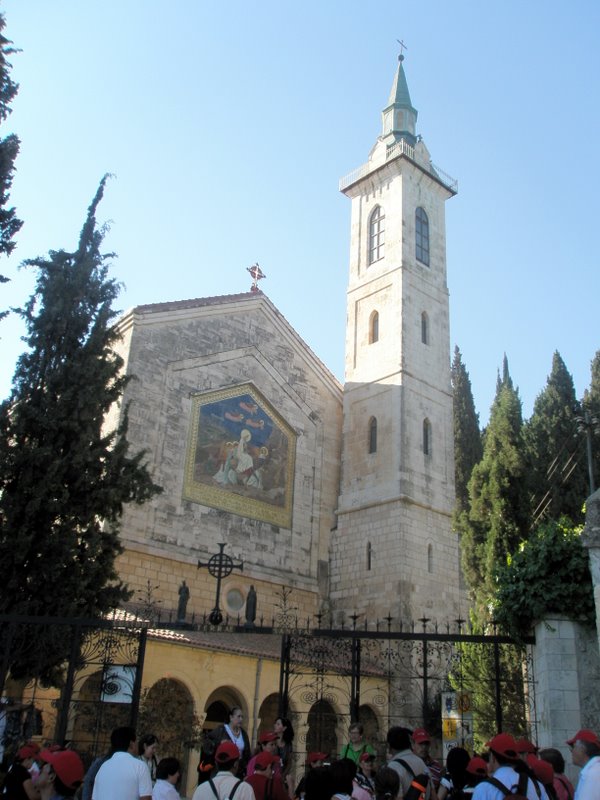
Another early start in a futile attempt to avoid the crowds.  We drove to Ein Kerem, a small town to the west of Jerusalem to the Church of Visitation.  It was here that Mary visited Elizabeth, soon to be, in old age, the mother of John the Baptist. The story is recounted in Luke, Chapter 1. 

Church of the Visitation
Mary's Well in the Church
Statue of Mary and Elizabeth

From Ein Kerem, we went to the Israel Museum where there is a very large and magnificent 1:50 scale model of Jerusalem in the late Second Temple period.  Our guide gave us a very interesting talk pointing out relevant areas on the model.  This proved invaluable in our visit to the Old City.

Model of the Old City
 While there, we also visited the Shrine of the Book where many elements and segments of the Dead Sea Scrolls are kept.  The shrine is beautifully developed and tells the story of the discovery of the scrolls at Qumran which we are scheduled to visit on Saturday. The Shrine of the Book is built to symbolize the scroll of the War of the Sons of Light Against the Sons of Darkness - The shrine is built as a white dome symbolizing the Sons of Light, and a black basalt wall - symbolizing the Sons of Darkness.

Shrine of the Book

As if all this was not sufficient for the day, if not for a week, time did not allow us that luxury and we moved on to Yad Vashem. As the Jewish people’s living memorial to the Holocaust, Yad Vashem safeguards the memory of the past and imparts its meaning for future generations. Established in 1953, as the world centre for documentation, research, education and commemoration of the Holocaust, Yad Vashem is today a dynamic and vital place of intergenerational and international encounter.

Holocaust Martyrs
 It is a place that is both uplifting and depressing.  The rooms which tell the story of the Holocaust often leave people in tears.  There is a shrine in which the names of the identified Holocaust victims are memorialised.  At the moment, more than 4,000,000 have been identified and Yad Vashem hopes to add another million before closing the project.

Hall of Names
We found the garden dedicated to the "Righteous among Nations," non-Jews who put their lives at risk to help rescue Jews during those terrible years, one of the most inspiring places there.

After a quiet and reflective lunch following such an emotional experience we headed to the West Bank and Bethlehem, the birthplace of Jesus. Bethlehem's main "business" appears to be tourism.  If you are not involved in tourism, you might well be one of the thousands who every day cross over into Israel to work.  It is an interesting anomaly that Palestinians can cross into Israel, but Israelis cannot cross into the Palestinian Territory.  Our guide could not accompany us as the local government does not allow Israelis into this "delicate" territory.  This was emphasized today since Abbas was about to address the United Nations and Israel generally is on high alert.  In the words of our guide, Aharon, "these are interesting times."

We were not allowed to take pictures of the check-point where delays can be long and difficult.  Being Jewish, I have to say I found the whole process of entering the territories left me somewhat uneasy.  However, our guide had made arrangements for us to be met by a local guide, a devout Christian which, as far as we were concerned, was the better option! There is one word to describe Bethlehem, "tacky."  It is certainly not the image portrayed on your traditional Christmas Card.

Jerusalem Cross
Towering over the Church of the Nativity is the Jerusalem Cross.  The big cross is Jerusalem and the 4 small crosses represent Germany, Italy, Spain and England (this makes it the "Crusaders" cross).  Alternatively the large cross is Jesus and the smaller crosses represent the four gospels.

By the way, if you are searching for really tacky postcards, Virginia found one with a picture of the Nativity Grotto superimposed with a Santa and his reindeer.  Beat that, if you can.  Manger Square and the Church of the Nativity are beautiful but money seems to change hands in order to get down into the actual grotto of the Nativity.
Low entrance to the Church of the Nativity
 Of course the guide had his own agenda which was to take us to his souvenir shop, which he runs partly to help the Christian community.  Virginia was happy to spend a few shekels here since the restrooms were exceptionally clean and we were immediately given a bottle of iced water (very welcome with the temperature in the high 30s) and we were then offered soft drink, mint tea and or wine.  This is salesmanship in anyone's language.  And it worked!  Numerous purchases of local jewellery as well as souvenirs were made.

Back through the gate where we were delayed for about thirty minutes and I think we all heaved a sigh of relief once we were back in the minibus.

After returning to the hotel and having dinner,  a group of us went on a guided walk of the Old City of Jerusalem. 

The Walls of the Old City at Night

The high point was a visit to the Western Wall of the Temple known colloquially as the "Wailing Wall." Located at the foot of the western side of the Temple Mount, it is a remnant of the ancient wall that surrounded the Jewish Temple's courtyard, and is one of the most sacred sites in Judaism outside of the Temple Mount itself.
At the Temple Wall
Orthodox Jews praying at the Wall

This was a big day! And tomorrow promises to be even bigger.
Wednesday, September 21, 2011

From Canna to Jerusalem

Today was the first day of Autumn but the temperature was still in the middle to high 30s.  We drove through Canna of Galilee where Jesus performed the miracle of the changing of water to wine at the wedding feast as told in the Gospel according to John.  For us, the miracle was that Ahron was able to get through the traffic here.

We arrived in Nazareth the home village of Joseph and Mary and the site of the annunciation (when Mary was told by the angel Gabriel that she would have Jesus as her son).   It is now a busy city of 75,000 people of which 70 per cent are Muslim and 30 per cent Christian.

Church of the Annunciation
 The population nearly doubles every day because of the vast influx of tourists.  Parking was at some considerable distance from the Church of the Annunciation.
Dome of the Church of the Annunciation
 A longish, up-hill climb, however, got us there where we visited the Church as well as the Church of St Joseph. 

The Church of the Annunciation is built around what is believed to be Mary's house and the Church of St Joseph is supposedly over his carpenter's workshop.

The Door to Mary's House

Station of the Cross
Church of the Annunciation
A comment from the Islamic population
Church of the Annunciation in the background

As we left the city, we couldn't help noticing the sign above.  While the local population may be unwilling to accept those who are not  Muslims into their heaven, they seem very happy to accept their money here on earth.

The next stop was at Beit She'an.  This ancient site's location has often been strategically significant, as it sits at the junction of the Jordan River Valley and the Jezreel Valley, essentially controlling access from the interior to the coast, as well as from Jerusalem to the Galilee. It was inhabited by numerous people over many centuries but on January 18, 749, an earthquake struck. City upon city has been uncovered by archaeologists, but the finest remains are those standing when the city was brought to an end in 749. 

Main Avenue
The Roman Theatre

A Public Latrine
 If, after going to the theatre, one felt the call of nature, there were public latrines.  Users entered an open courtyard paved with aq mosaic floor and lined along the walls with toilets, with no separation between them, and no evidence of a division between men's and women's facilities.

Even now, with less than half of the city uncovered, it is one of the great archaeological treasures. I am sure that my friends in the Classics at UTAS are seething with jealousy at the moment! I might just add that the temperature on the ground that day would have been around 45 degrees in the middle of the ancient ruins.

Lunch was Shawarma at an Israeli "take-away." Definitely not a tourist trap.

One of our group on a camel

On to border of Jordan through the west bank past Jericho and after a short stop for a Camel ride (in which we did not engage!) we rode into Jerusalem in our minibus.

Tuesday, September 20, 2011

It's Tuesday, this must be Capernaum!

We have spent a fair bit of time on the road so far, and it looks like there will be even more to come.  One of the things that stands out, particularly in the cities and towns through which we pass, is how beautifully landscaped the roundabouts are.

Our first stop today was at Caesarea-Philippi. This was an ancient Roman city located at the southwestern base of Mount Hermon. The city is mentioned in the gospels of Matthew, and Mark. It was located within the region known as the "Panion" (the region of the Greek god Pan). Named after the deity associated with the grotto and shrines close to the spring called "Paneas". Today, the city, now no longer inhabited, is an archaeological site located within the Golan Heights. It is one of the three sources of the River Jordan which flows into sea of Galilee 250 metres below sea level.

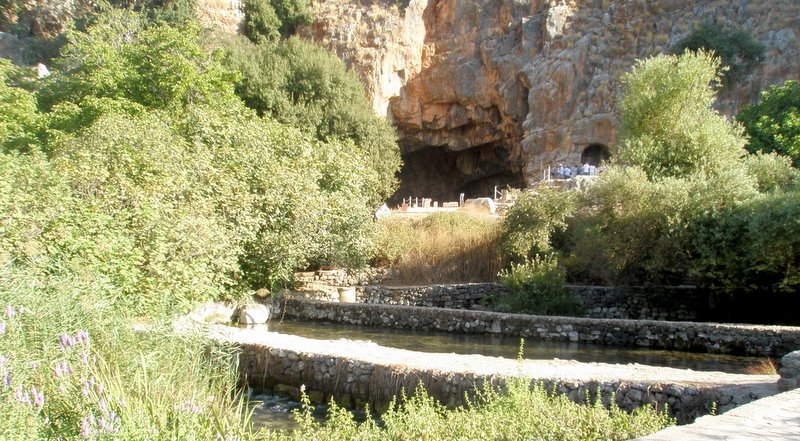
Grotto of Pan
 According to the New Testament, it was here that Jesus asked his disciples, "Whom do men say that I the Son of man am?" It was only Simon Peter who answered and said that he was the Christ, "The Son of the living God."  In the following passages, Jesus says to Simon Barjona, "thou art Peter, and upon this rock I will build my church; and the gates of hell shall not prevail against it."

Source of the Jordan
Our next stop was Korazin, overlooking the Sea of Galilee from a beautiful garden setting.  It is here that the "Sermon of the Mount" is supposed to have taken place.  Although there is no exact location, there is now an eight sided Catholic Church, each side representing one of the eight beatitudes.  It was built in 1936 of stone from Nazareth and Galilee, the places from which Jesus came.

Church of the Beatitudes

Our third stop (and we were already on information overload) was the Sea of Galilee itself.  Fortunately for our flagging energies, we were taken on a boat ride which was extremely peaceful.

Afloat on the Sea of Galilee
Once back on land, however, it was back into the bus to go to a point on the Jordan River where it is supposed that John the Baptist baptised Jesus.  This was a truly tacky site!  While it is not surprising that so many "religious" sites have become commercialized, this was really over the top.  Our guide, Ahron, is an archaeologist and his comment about the site was less than complimentary.  His view is that it is most unlikely that Jesus was baptised anywhere near this place.

Baptism site  in the Jordan

For lunch we stopped at a restaurant which specialized in serving "St Peter's Fish," so named from the story in the Gospel of Matthew about the apostle Peter catching a fish that carried a coin in its mouth.  Then  it was on to Capernaeum.

After lunch it was on to Capernaum. Located on the northern shore of the Sea of Galilee, it had a population of about 1,500. Archaeological excavations have revealed two ancient synagogues built one over the other.

Ancient Synagogue

The town is cited in the Gospel of Luke where it was reported to have been the home of the apostles Peter, Andrew, James and John, as well as the tax collector Matthew and in the Gospel according to Matthew, the town was reported to have been the home of Jesus. here Jesus taught in the synagogue on Sabbath and healed a fever in Simon Peter's mother-in-law. It was to become the centre of his public ministry in the Galilee after he left Nazareth.  Our guide confirmed that there is little doubt that this site is what it is proported to be.

St Peter's House


The day wore on and our next stop was the Church of Multiplication at Tabgha. There is a church built on the site where Jesus fed 5,000 people with 5 loaves and 2 fish.  The Church has a wonderful 4th Century mosaic floor representing the miracle of the loaves and fishes reported in each of the gospels.

Mosaic Floor
It was a great relief to stop at a winery in the Golan Heights for a wine tasting.

Golan Heights Winery

Refreshed we drove further into the Golan where we could look out over the border with Syria. Here Ahron spent some time with us discussing the geopolitical realities of the Yom Kippur War.  He had served in the Sinai during that conflict.  Ahron's father was in the Israeli Defence Force (IDF).  Ahron had served his three compulsory years and now his children were doing the same.  Every Israeli is required to serve in the IDF (three years for men and two for women) and then the men are expected to be a part of the active reserve until the age of forty-five.

Finally back to the Kibbutz, dinner and bed!

Monday, September 19, 2011

A Long Day, Monday

The Roman Theatre
We were off to an early start with Ahron our guide.  The ten of us piled into the mini bus and headed for Caesarea. This is an interesting place with a Roman theatre and a Hippodrome for chariot racing.  One major problem however, was a lack of a water supply.  To overcome this problem, two aqueducts were built to provide the necessary water for the city.  After a brief look around we drove to the nearby aqueduct.

The Aqueduct for Caesarea

From Caesarea we drove inland to Megidda. In ancient times Megiddo was an important city-state. It is also known alternatively as Tel Megiddo (Hebrew) and Tell al-Mutesellim (Arabic). Megiddo is a tel (hill or mound) made of 26 layers of the ruins of ancient cities in a strategic location at the head of a pass through the Carmel Ridge, which overlooks the Valley of Jezreel from the west. The name Armageddon mentioned in the New Testament may derive from Har Megiddo (Hebrew) meaning Mount of Megiddo.

Steps at Megiddo

We had lunch at a very pleasant Druze restaurant. The Druze community in Israel is officially recognized as a separate religious entity with its own courts (with jurisdiction in matters of personal status - marriage, divorce, maintenance and adoption) and spiritual leadership. Their culture is Arab and their language Arabic but they opted against mainstream Arab nationalism in 1948 and have since served (first as volunteers, later within the draft system) in the Israel Defence Forces and the Border Police. The Druze community in Israel has a special standing among the country's minority groups, and members of the community have attained high-level positions in the political, public and military spheres.

The Bahai Gardens at Haifa

By now the weather was heating up and we were on to our next stop, Haifa.  This is a beautiful city and is the largest city in northern Israel, as well as the third-largest city in the country, with a population of over 265,000. Haifa is a mixed city: 90% are Jews, more than a quarter of whom are immigrants from the former Soviet Union, while 10% are Arabs, predominantly of the Christian faith. It is also home to the Bahai World Centre, a UNESCO World Heritage Site. The Bahai Gardens are absolutely magnificent.  Haifa is a modern, major port with cruise ships.  The volume of cruise ships arriving is considered by many to be a barometer measuring the safety of Israel at any given time.

Our final stop for the day was Acre. Under the citadel and prison of Acre, archaeological excavations revealed a complex of halls, which was built and used by the Hospitallers Knights. This complex was a part of the Hospitallers' citadel, which was combined in the northern wall of Acre. The complex includes six semi-joined halls, one recently excavated large hall, a dungeon, a dining room and remains of an ancient Gothic church. The city is ancient with a wonderful market through which we wandered and we finally left via a secret passage , recently discovered, which gave the Crusaders a secret route to the harbour.The markets of the old city are a delight: the 18th century Turkish bazaar, full of small artisan shops where you can haggle for souvenirs; the Shuq al-Abiad arcade with narrow passageways full of grocery stalls; and the vibrant street market along the main road, which sells everything from fresh fish and baked pastries to spices and perfumes - a glorious profusion of colours and smells.

The Crusaders' Castle at Acre
Inside the Crusaders' Palace
Utterly exhausted and totally sated with the wonders of the day we headed back through Galilee along the Jordan border to Kfar Gilad, the Kibbutz where we will be spending two nights. This is situated in the North-western tip of Israel right against the border of Lebanon and from our hotel room window it was only about 100 metres to the line of demarcation.

Sunday, September 18, 2011

Jaffa, Sunday


The Mediterranean Sea from Jaffa with
Tel Aviv in the background
This morning we took a tour to Jaffa, a truly amazing place.  It is now part of Tel Aviv although it existed for centuries before Tel Aviv was even a gleam in its founders' eyes.  The drive down is along the beautiful coast which is reminiscent of Marseilles with many bathing beaches.  The beaches are public with one exception which is a "religious" beach where men bathe three days of the week and women three days.

Modern Tel Aviv from Old Jaffa
Jaffa is an ancient port city, possibly the oldest in the world.  It is mentioned in both the old and the new testaments. It is one of the cities given to the Hebrew Tribe of Dan as port-of-entry for the cedars of Lebanon for Solomon's Temple, it was the place whence the prophet Jonah embarked for Tarshish and was the port-of-entry for the cedars of Lebanon for the Second Temple of Jerusalem.


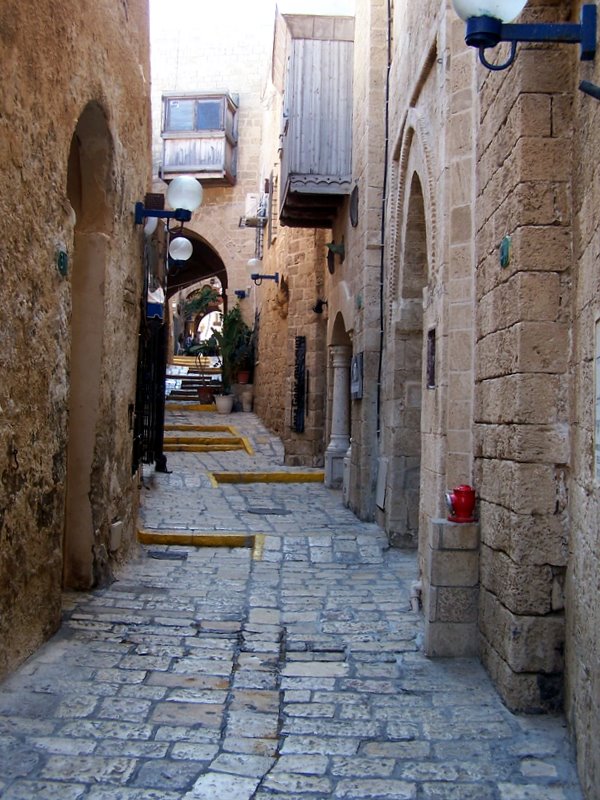
Old Street in Jaffa
For Christians Jaffa is particularly interesting because at the house of Simon the Tanner. The Apostle, Peter, raised Tabitha from the dead.

Street Sign in Old Jaffa

On March 7, 1799 Napoleon I of France captured the town in what became known as the Siege of Jaffa, ransacked it, and killed scores of local inhabitants. Napoleon ordered the massacre of thousands of Muslim soldiers who were imprisoned having surrendered to the French.

Modern Jaffa is still very much the city of ancient times.  It has three Synagogues, three Churches and three Mosques. It is an amazing feeling to walk on stones that have been in the narrow alleyways for more than 2,000 years.

Old Jaffa Synagogue

In the afternoon we went to the Israeli Diamond Centre.  This is the biggest diamond centre in the world, eclipsing Antwerp.  Here diamonds are bought, sold, cut and polished.  There is a very interesting museum with displays of famous diamonds as well as interesting stones and designs.

Saturday, September 17, 2011

Arts and Beaches, Saturday

The Beach at Tel Aviv
Today, of course, is the Sabbath so many businesses are closed during the day or at least through the morning.  Following breakfast we went for a stroll along the beach.  The people of Tel Aviv seem to really enjoy living on the sea.  The beaches were crowded and the eating and drinking places which encroach on the beach itself were packed.  We stopped for a coffee and did some crowd watching.

Beach Umbrellas
The part of the city in which we are staying is very similar to the Gold Coast in Australia or Miami Beach in Florida, at least as it was in the 1950s. 

Some observations.  To take a Taxi in Tel Aviv is to place your life in the hands of a madman.  Never, even in Paris, have we seen such disregard of road rules.  Cars move between lanes with no warning and if anyone slows up they are immediately notified that they have transgressed the unwritten code by loud and raucus horns from those behind them. And yet many people take their lives in their hands and ride bicycles.  These are not just the young, they seem to be a popular mode of transportation for many, regardless of age.  Recently, according to our friend Miriam, Tel Aviv has taken a page from other cities, setting up racks with public-use bicycles which can be rented for reasonable charges.  If you would like to know more about this, Miriam recently did an article on it which can be found at: http://esra-magazine.com/blog/post/tel-o-fun.

"Green" Bikes
Because Israel is constantly under threat, there is a very high and very obvious level of security. We have always thought the level of security in Paris was high, but in Tel Aviv, at the door to the hotel where one would expect to find the Concierge, there is a security guard, a young man armed with a pistol.  It is not uncommon to see members of the Israeli Defence Forces going home for the Sabbath, young men and women, in the streets with serious arms.

It is routine for everybody to pass through security under most circumstances.  When we went to the shopping centre yesterday, we went through a metal detector as well as having to open our bags.  Imagine the outcry in Australia or the United States if you had to do this every time you went to Westfield Plaza.

In the afternoon we went to the Tel Aviv Museum of Art.

The Tel Aviv Museum of Art
To go in, we went through the same process with our bags and the metal detector although we were less surprised since this is common in Paris in the galleries and museums although not found in the major London galleries. The museum building is interesting.  The entrance leads into a very large atrium-like space with a huge painting by Roy Lichtenstein on the wall.  The selection of paintings by the Impressionists and the Post-Impressionists was surprising with many works we had not seen before.  It is a great collection with many exciting modern works by Picasso, Miro, Modigliani and others.  There is some interesting sculpture at the front of the building as well.

Sculpture outside the Museum
Then it was back to the hotel, dinner on the beachfront and getting ready for tomorrow's expedition to Jaffa.

Dining on the Beach

Tel Aviv, Friday

The Mediterranean from the Hotel

 After a night in Luton, we headed for the airport anticipating delays due to the stringent security measures which we had been told characterized El Al, the Israeli national airline. These measures took the form of fairly extensive and detailed questions about why we were going to Israel and whether we knew anyone there. Despite this we were through to the boarding area in less than 45 minutes. The plane was about 30 minutes late arriving and once we were finally on board, there was a further delay. We had taxied out and were waiting in the queue to take off when they found an unidentified mobile phone on board.  This, of course, was a security issue and we had to go back and off-load it, losing our place in the queue.  Security with El Al is very tight.

Once on our way, the flight was completely uneventful and after about five hours we found ourselves in Israel. Ben Gurion airport is very modern, clean and pleasant.  The only trouble was, like so many airports around the world, long walks and no luggage carts.  We came through immigration where we were quizzed again and then, with nothing to declare, straight through with our bags and on to the hotel in Tel Aviv, about twenty kilometres from the airport.

This morning we went down to breakfast.  There are three elevators, two of which are quite ordinary.  The third is what is called a "Shabbat" elevator.  This is set up so that the user does not have to touch any of the buttons and therefore does not violate the injunction against working on the Sabbath. There are a number of different ways in which this is accomplished with the simplest probably being to have it stop automatically at every floor.  Naturally there is a lot of debate over whether this really avoids work.  What seems to be the greatest criticism is that it is almost a form of cheating.

Back to breakfast, however.  Of course the hotel is Kosher, so there was no meat on the buffet.  But there were about ten different cheeses, all sorts of breads and at least a dozen fish dishes.  I could go on, but you get the idea.  It would be easy to gorge oneself.

In the afternoon we went to the biggest shopping mall in Tel Aviv.  Our main reason was to go to the top of the building for what was described as a spectacular view of the city.  Unfortunately the viewing area was closed!  As for the shopping mall, well it wasn't much different from the malls in other big cities.  If it wasn't for a few different shops and the writing being in Hebrew, you could just as easily have been in Sydney, Melbourne, Miami, Los Angeles or New York.


Statue in front of the Mall
IDF airman drinking

No matter where you travel, you have the basic needs.  Foremost is getting your clothes cleaned and since the hotel doesn't have a "laundry room," and since it is Friday, the start of the Sabbath, the hotel doesn't have a service.  We took a walk and found a place which would do our dry cleaning and laundry.  Of course it will be closed on Saturday, but the clothes "should" be ready by Sunday evening.

We finished our first full day in Tel Aviv in the hotel bar with an old friend who settled here twenty-five years ago.  Miriam and I were in high school together and the last time we saw each other was more than ten years ago at our 45th high school reunion.  Have to say, it was a long time between drinks!